

Before and After
The Taking of Christ and Supper at Emmaus by Caravaggio

Did you see them? The pair of them - created in 1601/2 to be together but kept apart for centuries.
I nearly missed them. They’ve been in Belfast for months but I waited until the very last minute to trek through Botanic Gardens and stand in line outside the sanctuary in the Ulster Museum where the paintings were housed. Today they will exchange a farewell glance, descend from the wall and be sent home - one to the National Gallery in London and the other to the Jesuits in Dublin.
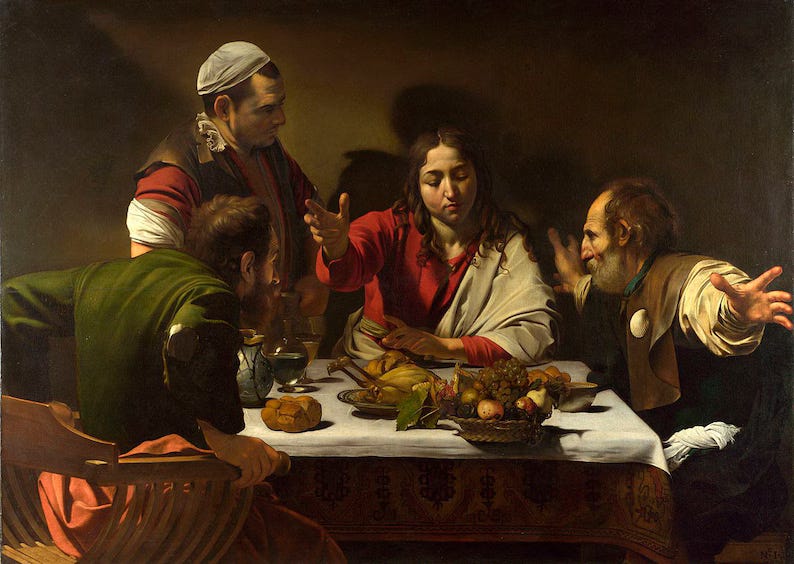
The Supper at Emmaus
I am in awe. Caravaggio was the master of chiaroscuro - the contrast between light and dark played out in moments of high drama. I stand in wonder and a little girl beside me asks loudly, ‘Who’s the lady in the middle?’ The child is held aloft in her mother’s arms and she is smiling into the face of Jesus. I feel the woman reaching for a politically correct response. Can we still call Jesus a man - the embodiment of a God who is compared to a mother comforting a child, a hen protecting her chicks. The woman mutters something about men having long curly locks ‘in those days’.
I sense that the child has seen something more. She is drawn to the extraordinary feminine beauty of the risen Jesus. Through his beatific expression, the shekhinah of God pours out in colour and contrast. The Master is not looking at the disciples, or the innkeeper. One hand blesses the very ordinary loaf and the other reaches out in invitation to the vacant space at the table - to you and me. To the little girl. Perhaps she senses the loving welcome and is not afraid. One of the disciples at the table is wearing a pilgrim’s scalloped brooch. I hope the moment when innocent meets divine marks the beginning of the child’s own pilgrimage.
It’s the hands that speak to me. Cleopas grips the chair about to propel himself to his feet and back to Jerusalem to share the good news. ‘He’s alive!’ The other disciple spreads his arms wide, in cruciform. His ecstatic excitement references both what has gone before and what may yet await him. But this moment is about life - the victory over evil and the triumph of sacrificial love.
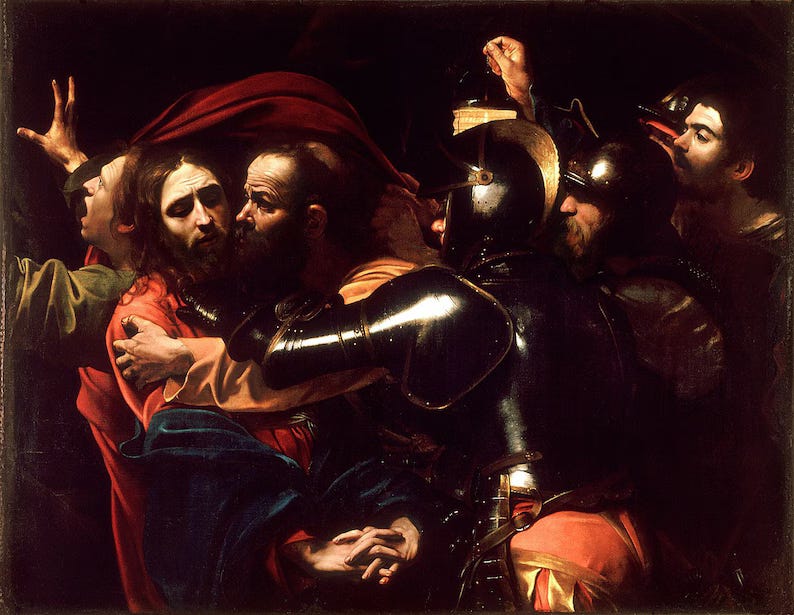
The Taking of Christ
Beside him on the wall is a very different Jesus - he looks years older rather than days younger. This time his hands are clasped in resignation, acceptance and surrender as soldiers and frightened disciples crowd the confused scene. Here is sound, instead of silence. It is the moment of arrest in the garden, tinged with anger, fear and, worst of all, betrayal by a Judas kiss.
Caravaggio has depicted himself in this painting - raising a lantern, shedding light. He is present, but not complicit. He cannot, however, prevent what is about to happen. Like The Supper at Emmaus, this scene is in the evening. Moonlight glints off the soldiers’ black amour. Light catches Jesus’ brow, furrowed in pain. He has just asked if the cup of sorrow can be removed. The answer is no and he submits to the will of the Father. This is the taking, but it is also the giving. A willing sacrifice unto death.
My thoughts wander to the ‘valley of the shadow’ in Psalm 23. This poem moves from the third person ‘he leads me beside quiet waters’ to the second, more intimate voice, ‘you are with me’. The final image is also a table spread in preparation. One comes before the other - the dark night precedes the feast.
My favourite poem this week is Wendell Berry’s short verse To Know the Dark.
‘To go in the dark with a light is to know the light.
To know the dark, go dark. Go without sight,
and find that the dark too blooms and sings,
and is travelled by dark feet and dark wings.’
We are not alone in the dark spaces. The feast will be spread in the presence of our enemies. The cup will overflow. Jesus accepted the cup of suffering so he could raise a glass with us in his new place. Soon.
So where do I fit in? Am I the disciple who is delighted to recognize the risen Christ or the one who betrays him with a kiss?
I’d like to be the little girl who who simply sees Jesus as the beautiful lady who loves me.
I love this mum, there is both light and dark in this piece, and such helpful signposting for those struggling not to turn the light on. I wish I had seen the paintings x