Old Bones

It was a wet Wednesday in Belfast. I was back on an old stomping ground a stone’s throw from the bottom of the Oldpark Road where I grew up. As I battled with my umbrella, I tried to keep an eye on the soaring spire of Carlisle Memorial Church which housed the Van Gogh exhibition: The Immersive Experience.
Little did I realise that it would be a red-letter day for me. I did not yet know about its sorrows. In the dark recesses of this stone house of worship, I was truly immersed – in colour, movement and extraordinary beauty. Roofs, cypress trees, night skies and flowers – multitudinous flowers – swirled and danced on the walls and ceiling. It was electrifying and exhilarating, and I was transported into the mystical world of this talented and tortured soul.
For me it was a truly uplifting encounter with art, beauty and genius. Van Gogh was a spiritual man but one not at peace. Quotations swam along the walls: ‘I put my heart and soul into my work, and I have lost my mind in the process.’ It was difficult for him to reconcile his art with his religion. I wanted to protest – to say that he had lost nothing but given everything of who he truly was.
Vincent Van Gogh died too young – at just 43. Nine hundred paintings in 10 years. Experts suspect the painter was colour blind, but it did not stop him from loving yellow. He lived in the fast lane painting furiously while neglecting his physical and emotional health.
He lived a life of passion and intensity - a philosopher who left behind pithy sayings: Art is to console those who are broken by life.
Later that day I was to be broken by life. I received a phone call: Robert was dead - my younger brother was dead! Although he had been ill, his sudden death was a horrible shock. Taken too soon. In the prime of life – looking forward to two grandchildren this year, living life large, in recent months travelling to Kenya and Tanzania with work, to France on holiday and to Germany to welcome a new little Irish warrior.

Robert’s daughter said that he believed he was created late on a Friday afternoon when there were only spare parts left. Over the years, his body was ravaged by illness. She added, ‘He was never going to see old bones.’ Nor did Van Gogh – there are people who live very full lives and then die young – fulfilling their destiny in double time while the rest of us wander through our days. Their job is quickly done and done well.
Poetry brings comfort – other people’s words when your own dry up. I have been reading former Archbishop of Canterbury Rowan Williams’s book A Century of Poetry. One haunts me for its beauty. Welsh poet and parish priest, Euros Bowen, imagines Lazarus newly risen from the dead and emerging from the tomb. Why does he say nothing about where he has been? Why does no one ask? The poet focuses on the frontier between life and death. The verses are alive with physical sensations. Lazarus recalls the moment of ‘dark sickness’ before death. How much brighter now is the light! How sharp the taste buds, how pleasurable the breathing and smelling!
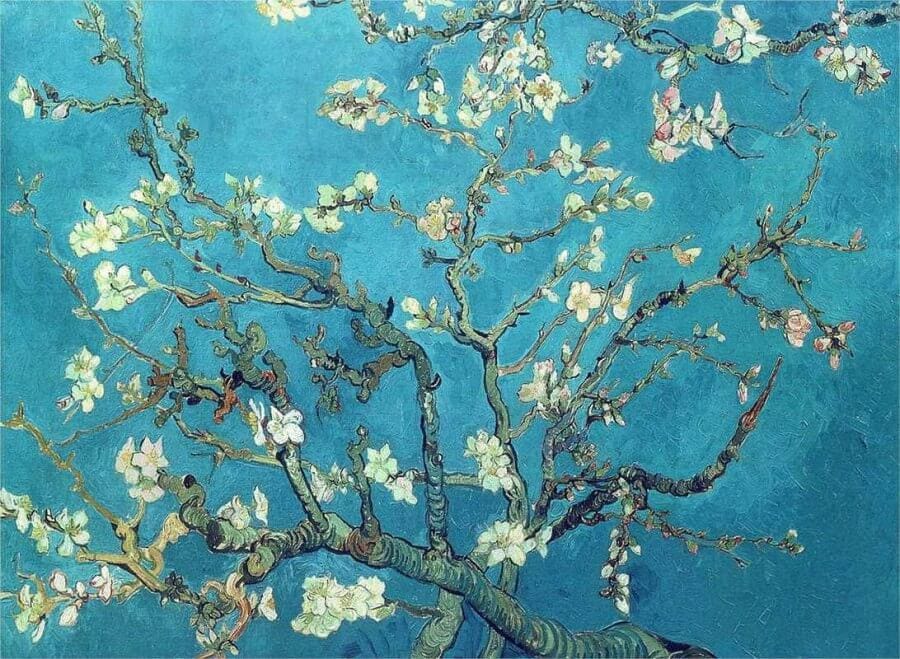
The final image of the poem is the cascading almond blossom. I am back in the Van Gogh experience where the miracle of technology causes almond blossoms to descend and descend in a shower of creamy white kisses.
The artist lives on his exquisite images – lauded after his death as he was not in life. The poet captures the moment of resurrection – new life after death. Both sing peace into my grieving heart. Beauty brings consolation and hope.
Van Gogh’s parting words were ‘the sadness will last forever’. I am sad that he was so sad. Sadness can rob us of life or propel us forward into living in this moment and then the next, with gratitude.
CS Lewis also wrote about another country where the grass is too sharp to walk on and flowers are hard like diamonds - a world too real for newly arrived mortals to comprehend. In his fantasy The Great Divorce he imagines a journey from a grey town to a place of endless light and joy. There bright people welcome the newcomer, and the trials of former lives are absorbed into fresh possibilities. The focus is on all things being made new.
At the end of his adventure, the narrator’s attention is drawn towards the sunrise:
‘It comes! It comes!’ they sang. ‘Sleepers awake! It comes, it comes, it comes… The morning! The morning!’